
Choosing a residential water booster pump is not simply a matter of buying the highest-pressure model. The right choice depends on pipe length, household demand, incoming water pressure, elevation, and available power. A two-storey home with three showers needs a different solution from a small apartment with one bathroom. Pressure matters.
Pump engineer and author Heinz P. Bloch is often quoted as saying, “A pump problem is often a system problem.” That warning is highly relevant here. A residential water booster pump may appear powerful on paper, yet perform poorly when paired with narrow pipes, clogged filters, undersized wiring, or an incorrectly adjusted pressure tank. In real installations, a pump can run loudly at midnight because a small leak keeps triggering it. That detail is easy to miss.
This guide explains how to compare flow rate, pressure range, motor capacity, control methods, noise levels, and maintenance needs. It also considers practical installation conditions, such as a basement water tank, a long supply line, or fluctuating municipal pressure. Readers should check manufacturer data and consult a qualified plumbing professional before selecting equipment. Product labels can be confusing. My own judgment would be cautious, too, because household usage is rarely as predictable as a specification sheet suggests. A reliable choice should deliver steady pressure without constant cycling, excessive energy use, or uncomfortable vibration. The best residential water booster pump is not necessarily the strongest one. It is the one correctly matched to the home, water source, and daily routine.
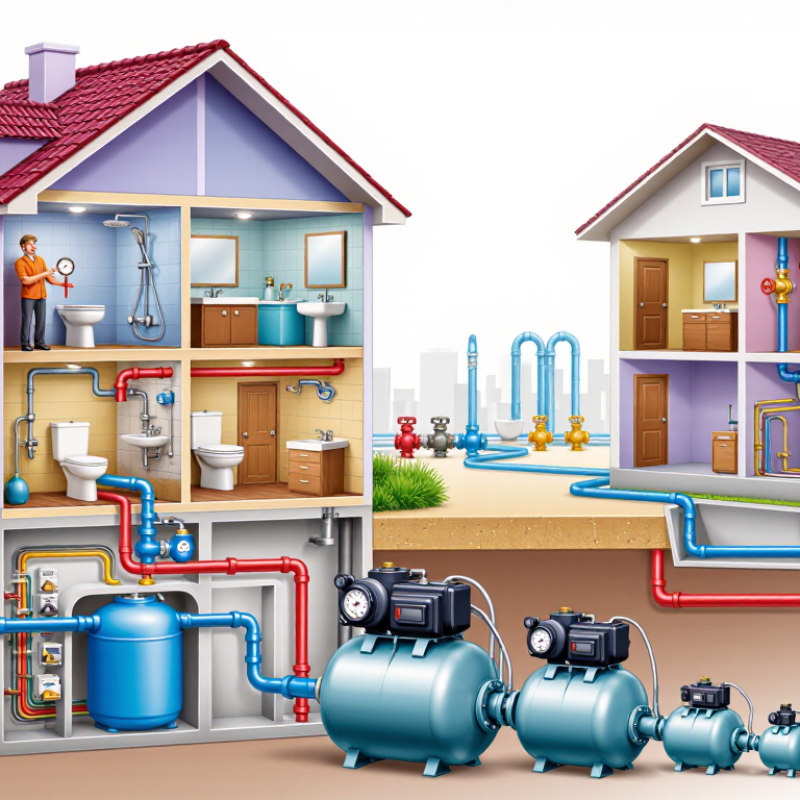
Choosing a residential water booster pump starts with measuring pressure and flow, not guessing from pipe size. Check static pressure with no fixtures open, then measure dynamic pressure while a shower or faucet runs. A pressure gauge and a timed bucket test reveal the real condition. A pump that looks powerful on paper may still disappoint during simultaneous use.
Many homes aim for about 40–60 psi at fixtures, although local codes and building height can change that target. Elevation matters: every 2.31 feet of rise removes roughly 1 psi. Add pipe friction, filters, softeners, and valves to the calculation. The pump must deliver the required flow at the remaining pressure. Do not select by horsepower alone. That shortcut is common, and sometimes wrong.
The Water Research Foundation’s Residential End Uses of Water, Version 2, found average indoor use near 58.6 gallons per person daily. Showers, toilets, and faucets represented major portions of that demand. WaterSense specifications also limit efficient showerheads to 2.0 gallons per minute and bathroom faucets to 1.5 gallons per minute. These figures help estimate demand, but household habits vary sharply. A family running two showers, a washing machine, and a kitchen tap needs a different design. Record your peak use for several days. I would also question unusually low readings, because a partly closed valve or clogged filter can imitate weak municipal pressure.
| Home Requirement or Sizing Factor | Typical Residential Range | Recommended Design Value | What It Means for Pump Selection |
|---|---|---|---|
| Acceptable water pressure at fixtures | 30–60 psi (2.1–4.1 bar) | 40–50 psi (2.8–3.4 bar) during normal use | Choose a pump and control system that can maintain the target pressure without frequent cycling or excessive pressure. |
| Minimum pressure for comfortable household use | Approximately 30 psi (2.1 bar) | At the most distant or highest fixture | If pressure falls below this level when several fixtures operate, a booster pump may be required. |
| Maximum recommended residential pressure | Normally not above 80 psi (5.5 bar) | Use a pressure-reducing valve when necessary | Pressure above 80 psi can damage plumbing fixtures and appliances and may require code-compliant pressure regulation. |
| Small apartment or one-bathroom home | 5–10 gpm (19–38 L/min) | About 8 gpm (30 L/min) | A compact variable-speed or pressure-controlled booster can usually support one or two fixtures at the same time. |
| Average two- to three-bathroom home | 8–15 gpm (30–57 L/min) | About 12 gpm (45 L/min) | Size for realistic simultaneous demand, such as a shower, toilet refill, and kitchen faucet operating together. |
| Large home or four-plus bathrooms | 12–20 gpm (45–76 L/min) | About 15–18 gpm (57–68 L/min) | A larger multistage or variable-speed system may be needed, especially with long pipe runs or multiple floors. |
| Typical shower flow | 1.5–2.5 gpm (5.7–9.5 L/min) | Use the actual fixture rating where available | Multiply the expected number of simultaneous showers by the fixture flow, then add other likely demand. |
| Typical bathroom faucet flow | 0.5–2.2 gpm (1.9–8.3 L/min) | Use the faucet’s rated flow | Low-flow fixtures reduce the required pump capacity and can improve pressure stability. |
| Typical toilet refill demand | Approximately 2–5 gpm (7.6–19 L/min) while filling | Allow for short-duration demand | Include toilet refill flow when it is likely to overlap with shower or faucet use. |
| Typical washing machine demand | Approximately 2–5 gpm (7.6–19 L/min) | Use the appliance specification | Although the inlet operates intermittently, its demand can affect pressure when other fixtures are in use. |
| Typical dishwasher demand | Approximately 1–2 gpm (3.8–7.6 L/min) | Use the appliance specification | Usually a secondary load, but it should be considered in a whole-home demand estimate. |
| Static inlet pressure | Pressure with no water flowing | Measure at the pump inlet | A high static pressure does not guarantee adequate pressure during flow; pressure loss must be measured under demand. |
| Dynamic inlet pressure | Pressure while fixtures are operating | Measure at the expected peak flow | This is one of the most important measurements because a restricted supply can limit pump performance. |
| Pressure increase required | Commonly 15–40 psi (1.0–2.8 bar) | Target outlet pressure minus minimum inlet pressure | Do not select a pump based only on its maximum pressure; check its pressure at the required flow rate. |
| Pressure loss in household piping | Depends on pipe size, length, fittings, and flow | Calculate or verify under peak demand | Small or undersized pipes can create substantial losses, and a larger pump may not correct a plumbing restriction. |
| Vertical lift requirement | 0.433 psi per vertical foot (0.098 bar per metre) | Add the elevation from the pump to the highest outlet | Elevation reduces available pressure. For example, a 20 ft (6 m) rise requires approximately 8.7 psi (0.6 bar). |
| Total dynamic head | Pressure requirement plus elevation and friction losses | Convert the final pressure to pump head | 1 psi is approximately 2.31 ft of water head, or 0.703 m of water head. Use the pump curve at the design flow. |
| Pipe connection size | Often ¾–1½ in (20–40 mm) in residential systems | Match the existing supply where practical | Do not reduce the inlet below the pump manufacturer’s requirement; restrictive fittings can reduce flow and increase noise. |
| Control method | Pressure switch, flow sensor, or variable-speed control | Variable speed for steadier pressure | Pressure switches are simple, while variable-speed controls generally provide smoother pressure across changing demand. |
| Pressure tank function | Commonly used with pressure-switch systems | Precharge must follow the control manufacturer’s instructions | A properly sized tank reduces rapid cycling. Incorrect precharge can shorten pump and switch life. |
| Electrical supply | Common residential supplies include 120 V or 230 V, depending on location | Verify voltage, phase, current, and circuit protection | The pump’s electrical requirements must match the available circuit and local installation regulations. |
| Noise and installation location | Noise varies by motor, speed, mounting, and pipe vibration | Install on a stable base with vibration isolation where appropriate | Keep the pump accessible, protected from freezing, and away from sleeping areas when possible. |
| Water temperature and fluid quality | Use only within the pump’s rated limits | Confirm potable-water compatibility | Materials, seals, and temperature ratings must be suitable for domestic potable-water service. |



sale@harbertpump.com,
sale@harbertpump.com,
sale@harbertpump.com,
sale@harbertpump.com,
sale@harbertpump.com