
Choosing a flight controller is no longer a simple matter of comparing processor speed. Today’s drones carry cameras, navigation sensors, telemetry radios, and safety systems. A weak integration choice can create vibration, noise, or frustrating field failures. This guide examines how to choose a Cuav V5+ Flight Controller for different aircraft sizes, missions, and pilot experience levels.
Industry data shows why careful selection matters. The FAA’s 2024 Aerospace Forecast reported more than 850,000 registered civil drones in the United States, including recreational and commercial aircraft. Meanwhile, Drone Industry Insights continues to document strong growth in commercial drone adoption across inspection, mapping, agriculture, and public safety. More aircraft mean more demanding expectations for reliability, logging, redundancy, and maintenance. Those expectations should shape a controller decision.
The Cuav V5+ Flight Controller is built around the Pixhawk ecosystem and supports advanced autopilot platforms such as PX4 and ArduPilot. Its sensor layout, vibration isolation, power-management options, and communication interfaces deserve close inspection. PX4 documentation emphasizes correct sensor calibration, secure mounting, and consistent power delivery. These details sound ordinary. They are not. A loose screw beside a propeller can ruin an otherwise capable build. Specifications alone cannot guarantee performance. Real results depend on firmware configuration, wiring quality, electromagnetic interference, and testing discipline. I would not choose this controller only because it has more ports. The better question is practical: can it support your mission, payload, frame, and maintenance habits without creating unnecessary complexity?
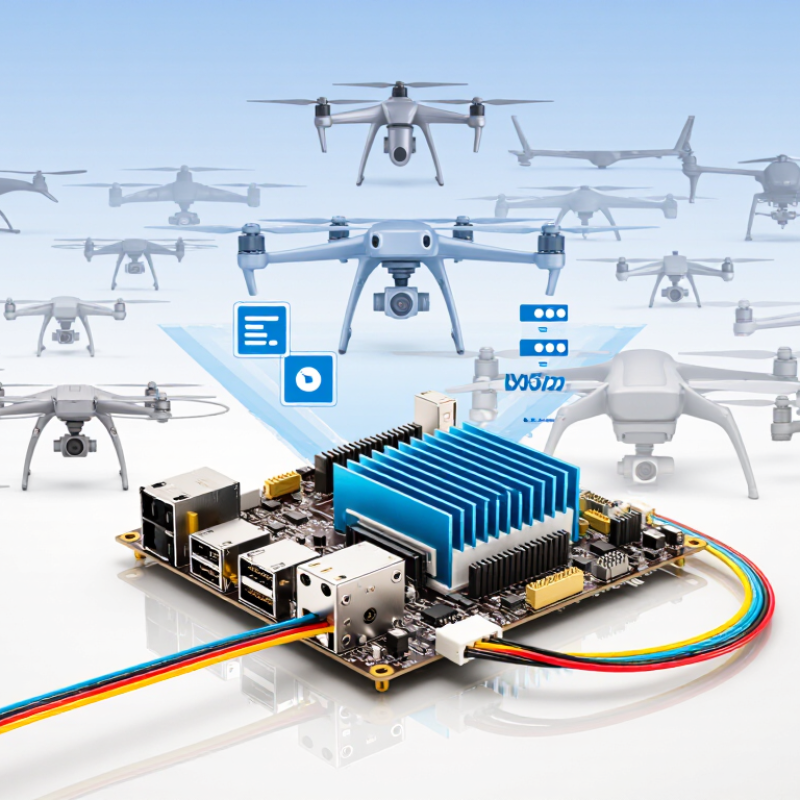
When choosing a professional flight controller, study its core hardware before comparing prices. A reliable board should offer dual inertial sensors, stable barometric measurement, and effective vibration management. These features help maintain accurate attitude data during fast turns and uneven motor output. I also check the processor’s capacity, because advanced navigation, camera control, and safety routines can compete for computing resources. More ports matter too. Multiple serial interfaces, CAN connections, PWM outputs, and expansion pads make future upgrades easier.
Power design deserves close attention. Look for separated power inputs, clear voltage limits, and dependable current monitoring. A loose connector can create misleading sensor logs or cause a sudden system restart. During bench testing, I examine solder joints, connector strength, and cable clearance around the frame. Small details matter. The mounting pattern should match the drone’s frame, while the controller should sit away from strong electrical noise. Soft mounting may reduce vibration, but excessive flexibility can make the sensor data worse.
I once focused too much on processor speed and overlooked installation space. That was a poor decision. A controller can have excellent specifications yet remain inconvenient in a compact frame. Before buying, confirm firmware support, calibration procedures, documented wiring, and replacement availability. Test the power monitor with a known load, then review flight logs after short, low-risk flights. Do not trust default settings blindly. Real performance depends on the entire aircraft, not the controller alone.
How to Choose Cuav V5+ Flight Controller for Your Drone
Matching the V5+ to your airframe starts with power, space, and mission demands. The controller suits designs needing multiple serial ports, CAN connectivity, PWM outputs, and redundant sensor options. Check the exact revision before purchase. Specifications can change between production batches. Its STM32F7-class processor provides useful processing headroom for navigation, logging, and communication tasks. However, headroom is not unlimited. Leave capacity for companion computers, range sensors, and future firmware features.
Measure the mounting pattern and stack height against your frame. A compact racing frame may lack room for vibration isolation and protected wiring. A heavy-lift platform needs a stable power module, clean grounding, and enough output channels for motors, gimbals, and landing equipment. During bench testing, inspect voltage rails with a multimeter. Do not rely only on software readings. The Global Commercial Drone Market report by Grand View Research estimated a 13.9% CAGR from 2023 to 2030, showing why scalable designs matter. Yet growth does not make every controller suitable.
Flight logs should guide the final decision. Review vibration levels, sensor consistency, processor load, and power noise during realistic tests. The V5+ may perform well on a six-motor platform, but poor cable routing can still create unreliable data. My first configuration used an oversized power system. It worked, but wasted space and added heat. A better match balances current demand, sensor placement, thermal airflow, and maintenance access. Drone Industry Insights has repeatedly identified reliability and operational efficiency as major commercial adoption factors. That makes careful integration more valuable than impressive specifications alone.
The flight controller should provide at least one motor-control output for every motor. A practical design margin is two additional outputs for testing, expansion, or actuator control. For battery compatibility, also verify the controller's supported cell range, logic voltage, serial interfaces, sensor redundancy, and current-sensing capability.
Choosing a V5+ flight controller requires more than checking processor speed. Sensor compatibility comes first. Confirm support for the required inertial sensors, barometer, compass, GPS, and airspeed sensor. Check voltage levels and communication buses, especially UART, I2C, CAN, and SPI. A sensor may use the correct connector but still fail electrically.
Motor and power compatibility matter just as much. Match the controller’s output protocol with the electronic speed controllers, then verify battery voltage, current sensing, and telemetry wiring. The FAA’s 2024 Aerospace Forecast reports more than 850,000 registered drones in the United States, showing how widely varied these systems have become. A popular connector does not guarantee safe integration. I have learned this the hard way.
Flight software can decide whether the hardware works at all. Check supported firmware versions, board targets, sensor drivers, and calibration procedures before installation. The PX4 Autopilot documentation recommends verifying actuator assignments and sensor orientation during setup. Open-source flight stacks also require careful parameter review. Small mistakes can reverse motor direction or corrupt altitude readings. Test without propellers. Always.
A 2023 European aviation safety review emphasizes risk-based testing and reliable operational procedures for unmanned aircraft. That principle applies on the workbench too. Record every wiring change, test one subsystem at a time, and leave room for doubt. Compatibility is not a checkbox; it is a measured result.
Choosing a V5+ flight controller requires more than checking processor speed. Power, mounting, and connectivity determine whether the aircraft remains stable under real operating conditions.
Start with the power budget. Measure the controller, receiver, navigation sensors, and telemetry devices together. The FAA Aerospace Forecast 2024–2044 recorded 855,860 registered drones in the United States by the end of 2023, showing how varied modern aircraft designs have become. A regulated 5V supply with sufficient current headroom is essential. Leave at least 30% spare capacity for startup surges. Thin wires can create voltage drops. I have seen clean bench tests fail after motors began drawing heavily. That mistake is easy to repeat.
Mounting deserves equal attention. Check hole spacing, frame clearance, vibration isolation, and connector direction before ordering. A rigid plate may transfer motor harmonics directly into the sensors. Soft mounts can help, but excessive movement may confuse attitude estimates. Measure twice. Also inspect screw length; a screw that reaches the circuit board can cause permanent damage. Connectivity should match the mission, not the feature list. Count serial ports, controller-area network ports, telemetry paths, and spare inputs. GSMA Intelligence’s Mobile Economy 2024 forecasts more than eight billion 5G connections by 2030, yet cellular links still cannot replace dependable local control. Keep critical commands on a dedicated link. My own preference is conservative, although it can leave unused ports and extra weight. That trade-off needs honest review.
Choosing the right flight controller configuration matters more than selecting the highest specification. A capable board still fails when power, sensors, and firmware are mismatched. The FAA’s 2024 UAS by the Numbers report lists more than 850,000 recreational and 330,000 commercial drone registrations in the United States. That scale makes dependable setup practices increasingly important.
For safe flight performance, choose a configuration with adequate processing capacity, isolated inertial sensors, and reliable power filtering. A regulated power module should maintain stable voltage during motor acceleration. Keep the controller away from high-current wires and secure it with soft vibration dampers. Check the sensor orientation twice. Small alignment errors can produce sharp attitude corrections. Include GPS, compass, and receiver redundancy when the mission requires stronger recovery options. Configure battery failsafes conservatively, not optimistically. The FAA recommends preflight planning, control-link checks, and battery assessments before operation. These steps remain useful, even for experienced pilots.
I once trusted default settings too much. That was careless. Test every failsafe with propellers removed, then review flight logs after a short hover. The European Union Aviation Safety Agency’s Annual Safety Review emphasizes data-driven safety management and consistent occurrence reporting across aviation. A practical configuration should therefore support clear logs, stable firmware updates, and easy maintenance. More features are not always safer. Weight, wiring quality, cooling, and operator skill can matter more than advertised performance.
| Configuration | Recommended Airframe | Typical Motor Count | Power-System Considerations | Sensor and Navigation Priorities | Recommended Flight Profile | Safety Priority | Why Choose This Configuration |
|---|---|---|---|---|---|---|---|
| Compact Multirotor | Small quadcopter used for training, photography, or short-range testing | 4 motors | Use a regulated flight-controller supply within the voltage range specified by the current hardware manual. Keep motor power wiring physically separate from sensitive signal and sensor wiring. | A reliable primary inertial sensor, properly isolated mounting, and a correctly calibrated compass when navigation functions are enabled. | Manual flight, stabilized flight, and short autonomous missions | High | The simplest wiring layout reduces installation errors and makes vibration, power, and failsafe troubleshooting easier. |
| Heavy-Lift Multirotor | Large quadcopter, hexacopter, or octocopter carrying a camera or other payload | 4, 6, or 8 motors | Use a power module rated for the aircraft's maximum continuous current. Provide adequate voltage regulation, filtering, and cooling; do not power high-current loads directly from an unprotected controller rail. | Strong vibration isolation, accurate battery-current measurement, and dependable navigation sensors positioned away from high-current conductors. | Stable hover, slow payload transport, and controlled return-to-home operation | High | Additional motors can improve lifting capacity and control authority, but they require careful motor-order checks, load testing, and failsafe setup. |
| Long-Range Fixed-Wing | Fixed-wing aircraft requiring efficient cruise and extended telemetry range | 1 to 2 propulsion motors | Use a stable regulator with sufficient current for the controller, receiver, servos, and navigation accessories. Confirm that servo loads cannot cause a voltage drop on the flight-controller supply. | Reliable airspeed measurement where required, GPS-based navigation, and well-calibrated attitude sensors mounted away from vibration sources. | Assisted manual flight, waypoint navigation, and automatic return-to-home | High | This configuration favors efficient power distribution, dependable position estimation, and conservative navigation limits for extended flight. |
| VTOL or Hybrid Aircraft | Aircraft combining vertical takeoff and landing with fixed-wing cruise | Multiple lift motors plus one or more cruise motors | Separate and clearly labeled power paths are recommended for lift motors, cruise propulsion, servos, and avionics where the aircraft design permits. Verify current capacity during transition testing. | Accurate attitude estimation, dependable airspeed data, and carefully tuned transition logic with clearly defined emergency modes. | Vertical takeoff, controlled transition, efficient cruise, and vertical landing | High | Hybrid aircraft benefit from a configuration that supports more outputs and allows each flight phase to be tested independently before full automation. |
| Redundant-Sensor Setup | Aircraft used for research, inspection, mapping, or other missions where fault tolerance matters | Depends on the airframe | Use a monitored power system with appropriate filtering and, when supported by the system design, independent regulated supply paths for improved fault isolation. | Use compatible redundant inertial and navigation sensors, verify sensor consistency, and mount each sensor according to its installation requirements. | Conservative autonomous operation with monitored health and defined failsafes | High | Independent sensor data can improve fault detection, but redundancy only helps when wiring, calibration, software parameters, and power sources are also independently verified. |
| Development and Test Setup | Prototype aircraft, laboratory rigs, and first-flight validation platforms | Usually 4 motors or fewer actuators | Use a current-limited bench supply or a protected battery connection during initial configuration. Remove propellers before testing motors and outputs. | Prioritize accessible sensor status, clear telemetry, data logging, and repeatable calibration procedures. | Manual testing, controlled hover tests, and staged system validation | Medium | A simple, accessible layout makes it easier to verify orientation, motor order, failsafes, receiver inputs, and power readings before flight. |
| Selection rule: match the controller configuration to the airframe type, actuator count, regulated power system, sensor requirements, and intended flight mode. Before flight, verify firmware compatibility, board orientation, motor or servo output order, receiver failsafe behavior, battery monitoring, navigation settings, and return-to-home performance. Always follow the current hardware and software documentation for exact electrical limits. | |||||||
sale@harbertpump.com,
sale@harbertpump.com